
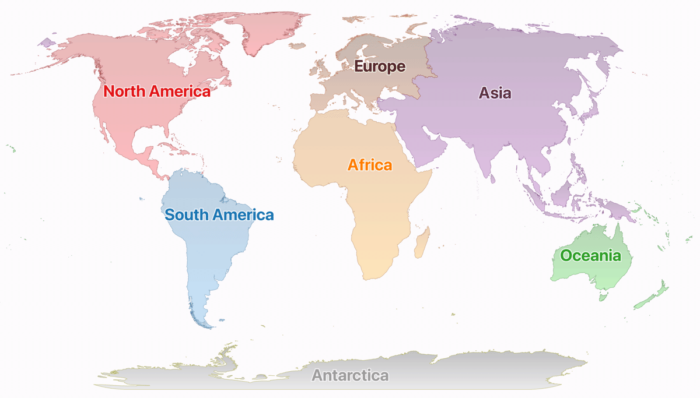
How many continents are there? The answer depends on the criteria used. While many people learn there are seven continents, geographers recognize anywhere from four to seven continent models based on physical geography, geology, and historical or cultural traditions.
In its simplest sense, a continent is a large, continuous landmass separated from others by oceans or other major natural barriers (Lewis and Wigen 1997). This approach groups land based on its physical form, but it is only one way of looking at Earth’s continents.
Some geographers classify continents using geological features such as tectonic plates or continental crust, while others emphasize historical and cultural traditions. For example, Europe and Asia are widely treated as separate continents despite sharing the same continuous landmass and the Eurasian tectonic plate. These different perspectives explain why there is no single universally accepted number of continents.
How Many Continents are There?
Geographers use several continent models to classify Earth’s major landmasses. The most common models recognize four, five, six, or seven continents, depending on how those landmasses are grouped.
Four continent model – smallest number of continents
The four-continent model recognizes the fewest continents: Afro-Eurasia, America, Antarctica, and Australia. It groups Earth’s landmasses according to their physical continuity, treating large, connected landmasses surrounded by oceans as single continents.
In this model, Europe, Asia, and Africa are combined into the supercontinent Afro-Eurasia because they form one continuous landmass. Likewise, North and South America are treated as a single continent, America, because they are connected by the Isthmus of Panama.

Seven continent model – highest number of continents
The seven-continent model recognizes Africa, Antarctica, Asia, Australia, Europe, North America, and South America as separate continents. It is the continent model most commonly taught in countries such as the United States, Canada, Australia, and much of Western Europe.
In this model, Europe and Asia are treated as separate continents despite sharing the same continuous landmass and the Eurasian tectonic plate. This distinction is based largely on historical and cultural traditions rather than physical geography. Likewise, North America and South America are recognized as separate continents, connected only by the narrow Isthmus of Panama.

Five- and six-continent models
The four- and seven-continent models represent the lowest and highest continent counts commonly recognized. Between these are the five- and six-continent models, which combine or separate landmasses in different ways. The animated graphic below shows how each classification results in a different total number of continents.
The five-continent model combines Europe and Asia into Eurasia while recognizing Africa, the Americas, Australia, and Antarctica as separate continents. The six-continent models either combine Europe and Asia into Eurasia or combine North and South America into a single continent, America, resulting in six continents overall.

Some international organizations use continent groupings for practical purposes rather than strict geographic classification. For example, the United Nations and the International Olympic Committee often do not include Antarctica because it has no permanent population and is not represented by sovereign nations.
Regardless of which continent model is used, continents also differ greatly in size and population. Asia is the largest and most populous continent, while Australia is the smallest and Antarctica has no permanent population.
What is the largest continent?
Asia is Earth’s largest continent, covering about 44.6 million square kilometers (17.2 million square miles). Africa is the second-largest continent, covering about 30.4 million square kilometers (11.7 million square miles).
What is the smallest continent?
Australia is the smallest continent, covering about 8.5 million square kilometers (3.3 million square miles). Surrounded by the Indian and Pacific Oceans, it forms a distinct continental landmass. Although Australia is sometimes described as the world’s largest island, geographers classify it as a continent because it sits on its own continental crust and encompasses an entire continent.
What is the most populated continent?
According to 2024 United Nations population estimates, Asia is the world’s most populous continent with about 4.8 billion people. Africa is second with about 1.5 billion people.
Table of Continent Size and Populations
The population estimates in this table are based on the United Nations Department of Economic and Social Affairs, Population Division. World Population Prospects 2024 Revision. Population figures have been adjusted where necessary to align with the continental definitions used in this article.
| Continent | Area (km²) | Area (mi²) | Percent of World Landmass | 2024 population estimate | Percent of Total World Population* |
|---|---|---|---|---|---|
| Asia | 44,614,000 | 17,226,000 | 29.60% | 4.81 billion | 59.5% |
| Africa | 30,365,000 | 11,724,000 | 20.20% | 1.52 billion | 18.8% |
| North America | 24,230,000 | 9,360,000 | 16.40% | 605 million¹ | 7.5% |
| South America | 17,814,000 | 6,878,000 | 11.90% | 663 million² | 8.2% |
| Antarctica* | 14,200,000 | 5,500,000 | 9.40% | 0 | 0% |
| Europe | 10,000,000 | 3,900,000 | 6.80% | 745 million | 9.2% |
| Oceania (Australia) | 8,511,000 | 3,286,000 | 5.70% | 46 million | 0.6% |
¹ UN reports Northern America rather than North America.
² UN reports Latin America and the Caribbean rather than South America.
References
Lewis, Martin W.; Kären E. Wigen (1997). The Myth of Continents: a Critique of Metageography. Berkeley: University of California Press. p. 21.
This article was originally written on September 18, 2023 and has since been updated.
Related resources:
Continents and Population Density: learn about the size and populations of each of the world’s continents. A basic worksheet for students to identify different continents and calculate population density for each of them.
